Collateral Actions-To-Facial Expressions Ratio as Indicator of Adaptation to Confinement from Earth to Space
Ethospace - Research and Study Group in Human and Space Ethology, Toulouse, France
Citation: Tafforin C. Collateral Actions-To-Facial Expressions Ratio as Indicator of Adaptation to Confinement from Earth to Space. SF J Aviat Aeronaut Sci. 2021;3(1):1015.
Abstract
Introduction: During interplanetary missions, space crews will have to adapt to unusual environments with restrictive living conditions like the unprecedented situation appeared on Earth to stay in good health and benefit from their experiences in an optimal way. Mental, behavioral and physical health is the goal of our studies in extended periods of time.
Method: The ethological approach was used to monitor behavioral manifestations of well being and stress feeling of confined crews in various ground experimental paradigms (MDRS-14d, SIRIUS- 120d, CELSS-180d and MARS-520d). The emphasis was on temporal factor, psychological factor and environmental factors through longitudinal, transversal and multifactorial analyses of small groups (n=4 to n=6).
Results: The ratio between collateral actions occurrences and facial expressions occurrences, during daily live activities, varies upon confinement durations, critical points and periods, extra-vehicular activities, multi-chamber facilities, multi-nationality and mixed-gender group. Positive balances are on multinational variable and synergy of variables.
Discussion: Over time, a behavioral stability punctuated by spikes about special events as after a high autonomy period, underlines adaptive responses. The 6-month time is critical. While confined on Earth like in Space, outdoor activities would have a positive effect on the emotional and physical states, between initial and final days of confinement. Synergic factors of crew's composition and habitat's conception are core component for minimum ratio as indicator of salutogenesis.
Conclusion: Video monitoring of such objective items observed, described and quantified, could be perspectives of application in telemedicine on Earth, and will help in designing human factor scenarios in Space.
Keywords: Well being; Stress; Human; Behavior; Isolated and Confined Environment (ICE)
Introduction
Confinement may include a number of different conditions such as a closed space, with
regulated life-support, with inner or outer dangers, with restrictive living context, becoming
monotonous, with proxemics or crowding, being an environment in which the crewmember is
somehow physically confined and socially isolated, inside small habitats. Recent confinements
on Earth imposed by pandemic situation led populations to stay at home during several-month
lockdown periods. The peculiarity of this event was to maintain physical distancing in the outside
world. Confined inhabitants had to adapt to living conditions by teleworking, virtual interacting
and conditional outings. Although the situation may have similarities with manned missions in
Space, one places the person in a safer condition and with the closest family members, while the
other one places the person in a condition of elevated danger and stress that is a space travel and
far away distances from family. Ground experiments in closed chambers were developed to study
these latter issues relevant to the impact on the individual and inter-individual behavior. Previous
ethological investigations made during campaigns of confinement ISEMSI (Isolation Study for
European Manned Space Infrastructure), EXEMSI (Experimental campaign for European Manned
Space Infrastructure) and HUBES (Human Behavior in Extended Space flight), over 28 days, 60
days and 135 days respectively, described changes in social behavior according to time [1]. Adaptive
strategies of small social groups with their distinctive characteristics are of prime interest in the
current research studies on mental, behavioral and physical health. Confinement is a complex
multifactorial environment where all the components, modeled or real ones, are significant.
Temporal factor exacerbates the impacts on the human reactions. It is a relevant variable to analyse in the dynamic process of crew's adaptation for long duration missions on the Moon or Mars. High autonomy becomes the specific demand in the crewmembers. Active communication strategies are accompanied by increasing in mood scores and activity levels of the confined crew over 135 days [2]. Findings on the changes in major mechanisms of unconconscious responses gave an overview of mental health over time, as for instance an increase in the psychological defense stress [3]. Cycles-related durations of actions vs. interactions were considered to be specific temporal points in the behavioral changes over 520 days [4]. Personal actions are any non-verbal actions performed by each person. In our objective observations on the whole crew, we found increasing mean durations of personal actions during collective meals every 35 days within the phase preceding Mars landing and every 70 days within the succeeding phase. Although the Third Quarter Phenomenon (TQP) was reported in many extreme conditions related to the time, there were not recurrent changes after the halfway point during confinements, such as for instance over 80 days inside the Lunar Palace 1 [5]. More broadly in conditions of off-Earth environments, behavioral health issues are raised as normal psychological reactions during extended periods of time [6].
Psychological factor with a focus on emotions is another variable to analyze in the salutogenic process of behavioral adaptation for efficient interplanetary missions. Individuals who adapt positively to unusual environments or unprecedented situations can derive benefit from their experiences, based on the concept of salutogenesis [7]. The beneficial effects are related to positive emotions as a result. Focusing on positive in addition to negative emotions in order to provide a complete understanding of individual risk and resilience [8] will improve the reliability of human factors by regulating stress feeling and well being. Facial expressions such as "smiling" and "laughing" vs. collateral actions such as "scratching the head" and "rubbing the nose" are relevant behavioral indicators. Collateral actions are small movements with no obvious function in the performance but are observable manifestations of stress and tiredness [9]. Releasing emotional charge through collateral actions is helpful. Enhancing facial expressions through humor was a strategy for coping with stressors in astronauts more in long-duration flights and upon nationalities [10].
Synergic factors of space crew feature and space habitat architecture are relevant variables to analyze in the optimal process of adaptation for mission success. With the extended time required for exploring distant planets, space travels become longer and space crews become more heterogeneous in terms of multinational background. Such characteristics reinforce cultural influences on behavioral manifestations in our human adaptation model [11]. Enduring isolation of interplanetary travel, cross-culture appeared as an advantage by sharing living experiences [12] against monotony. A disadvantage is the limited intra-vehicular activities (IVA). Our previous results in experimental confined environments showed that the facilities did not allow large body movements and displacements [1]. As for the small space habitats, this has an impact on the physical health.
In the present study, our theoretical hypothesis is that behavioral manifestations of stress feeling and well being occur in the adaptive strategies to cope with temporal factor, psychological factor and environmental factors of living conditions in confinement. Our working hypothesis is that the ratio between collateral actions occurrences and facial expressions occurrences, during daily live activities, varies upon confinement durations, critical points and periods, extra-vehicular activities, multi-chamber facilities, multi-nationality and mixed-gender group. Low levels (ratios < 1) are indicators of positive adaptation.
Materials and Method
MDRS-14d confinement
The Mars Desert Research Station (MDRS) is one of the space analog facilities operated by the American Mars Society for 2-week confinement campaigns. It is located in the desert of Utah-USA and gives scientists the opportunity to perform Earth-based research regarding Martian or Lunar research programs. We investigated the second EuroMoonMars campaign. The habitat (Hab) is a mono-cylindrical structure where the upper deck houses the living/working area, and the lower deck houses the laboratory and the EVA (Extra-Vehicular Activity) preparation room with spacesuit simulators.
The mixed-gender crew consisted in four nationalities, American, Australian, Danish and French (n=6), aged between 20 years and 55 years.
SIRIUS-120d confinement
The Scientific International Research in Unique Terrestrial Station (SIRIUS) program offers scientific opportunities to achieve confinements in different duration inside the Ground Test Complex (NEK) at the Institute of Biomedical Problems (IBMP) in Moscow-Russia. It is a multi-chamber facility of 4 hermetically sealed and interconnected modules for IVA, with a landing module, a working module, a living module and a storage module. A connected planetary surface simulator for EVA completes the complex. The presented 4-month experimental paradigm was of 120-day duration and simulated major milestones of a mission to the Moon: a transfer phase from Earth to an orbital Lunar station, a two-month stay with virtual docks of transport vehicles and a real Moon landing with EVAs. The mixed-gender crew consisted in two nationalities, Russian and American (n=6), aged between 28 years and 44 years.
CELSS-180d confinement
The Controlled Environmental and Life Support System (CELSS) platform was built at the Space Institute of Southern China (SISC) in Shenzhen. It is composed of 6 main interconnected modules with four greenhouses, one living chamber with crew's cabins and life support cabin, and one resource chamber. The 180-day experiment was a comprehensive paradigm that offered a bio-regenerative and physico-chemical regenerative technology, in 6-month duration total confinement without EVA. The mixed-gender crew was mono-national, Chinese, aged between 25 years and 45 years.
MARS-520d confinement
The Mars-500 program was a 520-day experimental paradigm that simulated different phases of a mission to Mars: a 250-day interplanetary flight from Earth to Mars, a 30-day orbital stay that included the Mars landing, and a 240-day interplanetary flight from Mars to Earth. It took place at the IBMP in Moscow-Russia in the same NEK as offered for SIRIUS program. The facility was composed of 4 chambers with the habitable module, the medical module, the storage module and the Mars landing module, interconnected to a Martian surface simulator for EVAs. Periods of high autonomy were simulated. The all-male crew consisted in four nationalities, Russian, Italian, French and Chinese (n=6), aged between 26 years and 38 years.
All the subjects in each situation gave their informed consent to participate in the experiments.
Ethological method
We applied the three methodological tools used in ethology, science of behavior, from video recordings collected during each confinement. Observations carried on the subjects' non-verbal behavior on a daily life activity at mealtime. The data collection protocol was on first and last day of MDRS-14d, twice a month of SIRIUS-120d and MARS-520d, once a month of CELSS-180d. Descriptions focused the analysis on two behavioral categories, collateral actions and facial expressions. The data encoding was supplied with the Observer XT ® software, designed to collect, organize and process observation data from video files. Quantifications of behavioral manifestations totalized the absolute occurrences per day ( ∑ subjects) and calculated the ratio between categories. We used non-parametric descriptive tests (linear trend-line R 2 , chi-square X 2 ) for significant statistics ( p -value).
The method is objective and non-invasive. Data analyses respect the anonymity.
Results
Given that the experimental confinements consist of different co-variables, we extracted from data protocols the most consistant mission days. The time variable was on the longest confinement for a longitudinal analysis. Focus on critical points and specific activities were for a transversal analysis. The main variables were integrated in a multifactorial analysis.
Longitudinal analysis
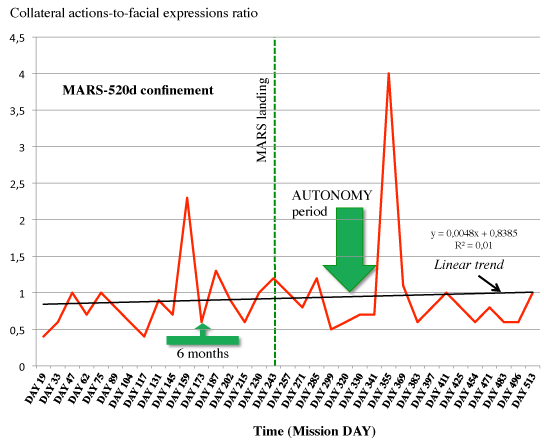
The Figure 1 presents the crew's behavioral manifestations regarding collateral actions-to-facial expressions ratio over Mars-520d confinement that simulated a long-duration mission to Mars. The analysis emphasizes temporal factor within day 19 and day 513. The results show variations of ratio over time with spikes about 6-month periods (day 159 and day 355). These specific temporal points with increasing levels, respectively 2.3 and 4 ratios, highlight episodic stress feelings in confinement on extended dynamic process. The flat linear trend (R 2 =0.01) shows independent association with time. Along with good selection and preparation, such temporal stability indicates that the crew is coping with anxiety-provoking conditions. Landing on Mars did not provoke emotional overload whereas special events of high autonomy period did it afterwards. These are adaptive responses and could reflect salulogenesis.
Transversal analysis
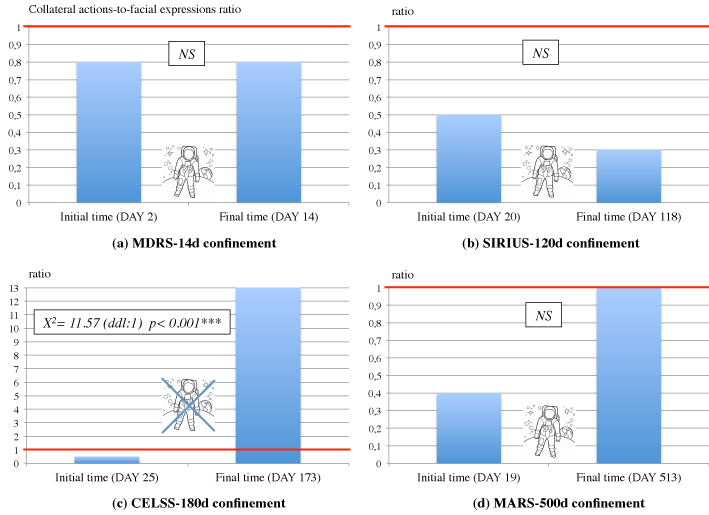
The Figure 2 presents the collateral actions-to-facial expressions ratio in the crews' behavior of MDRS-14d, SIRIUS-120d, CELSS-180d MARS-520d confinements that are in distinctive whole duration. The analysis provides a comparative view between the first days, respectively day 2, day 20, day 25 and day 19, and the last days, respectively day 14, day 118, day 173 and day 513. The results show positive balance-related ratios < 1 (collateral actions < facial expressions) independently of the longest days and no significant (NS) differences apart during CELSS-180d confinement. It was a strict confinement limited to IVA. Comparisons at specific temporal points highlight emotional states. The lowest ratio as behavioral manifestations of well being, at the initial periods of confinements, indicates that the crew psychologically anticipates the negative impact of time and any environmental variables, to mitigate stress feeling. It is a positive adaptive strategy. Absence of EVA significantly ( p< 0.001) increases stressful conditions. Differences upon gender are not obvious in the behavioral outcome as synergy of variables has a greater impact.
Multifactorial analysis
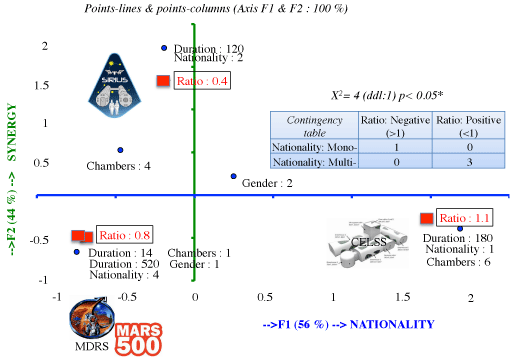
The Figure 3 presents conjunctions of variables and collateral actions-to-facial expressions ratios in four experimental paradigms (MDRS-14d: mono-chamber, bi-gender, multi-nation; SIRIUS-120d: multi-chamber, bi-gender, multi-nation; CELSS-180d: multi-chamber, bi-gender, mono-nation; MARS-520d: multi-chamber, mono-gender, multi-nation). The Correspondance Factorial Analysis (CFA) distinguishes clusters besides confinement durations according to axis F1 and axis F2 (contribution to both axes=100%). The results show that positive balance-related ratios ( < 1) are separated by the two axes with an emphasis on axis F1 (56%) from multi-nationality (MDRS-14d and MARS-520d: 4), bi-nationality (SIRIUS-120d: 2) to mono-nationality (CELSS-180d: 1). The contingency is significant ( p< 0.05). We named axis F1 "NATIONALITY" as corresponding factor. Multi-varied components (Gender: 2, Chambers: 4; Nationality: 2) along axis F2 (44%) separates SIRIUS-120d confinement from the other ones. We named axis F2 "SYNERGY" as corresponding factor. Synergic factors of crew's composition and habitat's conception are core component for minimum ratio (0.4) within a 4-month confinement as indicators of optimum in adaptation.
Discussion
The whole results support our working hypotheses that the ratio between collateral actions occurrences and facial expressions occurrences, during daily live activities, varies upon confinement durations, critical points and periods, extra-vehicular activities, multi-chamber facilities, multi-nationality and mixed-gender group.
A research-based solution of keeping crews healthy and active for as long as possible in confinement is to monitor mental health, behavioral health and physical health. The present methodological approach based on observations, descriptions and quantifications of behavioral manifestations is conducted at the interface. Our ethological analyses dealt with the fact that relationships between the individuals and their environments are stated as optimizing for best comfort and well being. The emerging behaviors in unusual settings are indicators of adaptation in order to answer questions regarding human performance and environment improvement.
How the crews develop adaptive strategies that underlie high performance with high autonomy for long duration interplanetary missions? We observed in the longitudinal analysis over a 520-day confinement (MARS-520d), high collateral actions-to-facial expressions ratio at two temporal points within 6-month period. Time-course changes in behavioral manifestations could be a positive way to activate emotional state against boring rhythm of daily life activities impacted by temporal factor, and to alert about emotional state for ground support if psychological issues. In the transversal analysis, low collateral actions-to-facial expressions ratio on the first day of a 520-day confinement indicates to what extent the crew anticipates the living confined conditions from long-term perspectives. The same ratio between the initial time and final time of a 14-day confinement (MDRS-14d) underlines how much the crew needs to release stress from overloaded short-term missions. Periods of behavioral stability punctuated by wide variations could be an alternative to develop adaptive strategies during super long confinements. High levels of collateral actions could be emotional states of alertness as before a critical point of 6 months, or in realising emotional charge as after a specific period of high autonomy. Such indicators could be used to predict behavioral changes according to mission days and mission events.
Independently of temporal factor, environmental factors with an emphasis on cultural environment and architectural environment have an impact on human behavior. The multifactorial analysis brought out multinationality as a core component in the crews' composition. We observed negative balance-related ratio as indicator of stress feeling in the mononational crew during CELLS-180d confinement whereas positive balance-related ratio as indicator of well being was linked to plurinational crews whatever the confinements. In addition, impacts of co-variables by including synergies between bi-nationality variable, mixed-gender variable and multi-chamber facility variable, like during SIRIUS-120d confinement, increased positive facial expressions and salutogenic adaptation as a result. Furthermore, while IVA was reduced in confinement, we observed beneficial impacts of EVA. Physical activities were enhanced during spacewalks out of the habitat when crewmembers simulated operations on the Martian surface (MDRS-14d and MARS-520d) or on the lunar surface (SIRIUS-120d).
What will help human adaptation to confinements for raising autonomy and breaking up monotony from social context and temporal dynamics? We may consider a multi-varied environment with alternating inside and outside activities, interacting within culture-based crewmembers, sharing positive experiences, emancipating from outside communications through combinations of crew feature and habitat architecture along with time, cycles and periods. That could be beneficial and effective ways to help confined inhabitants all over the world. Further investigations in the next confinements program will be relevant for further studies of the occurred changes in relation to contextual events as anticipative strategies. Human adaptability and space habitability have to be emphasized for quality of life and mission’s optimization.
In conclusion, our findings support the idea of good synergy between components of a confinement that contributes to the valuable diversity of a social group, the valuable performance in multi-activities and the valuable design of multi-facilities. The whole induce nominal variations of actions, expressions, interactions and communications according to the mission days for space exploration success [4,9,11]. The positive balance between indicators of well being such as facial expressions vs. indicators of stress feeling such as collateral actions monitored during ground experiments will help in designing human factor scenarios of travels to the Moon and Mars. New perspectives would be to consider these objective items to be observed, described and quantified from video recordings [13], in sanitary context like the pandemic crisis on Earth for telemedicine applications.
Acknowledgments
The whole research received the financial support from French Space Agency (CNES). Thank you to all the participants in both experiments as ground teams and confined crews.
References
- Tafforin C. Ethological indicators of isolated and confined teams in the perspective of missions to Mars. Aviat Space Environ Med. 2005; 76: 1083- 1087.
- Gushin VD, Shved A, Vinokhodova G, Vasylieva G, Nitchiporuk I, Ehmann B, et al. Some psychophysiological and behavioral aspects of adaptation, to simulated autonomous Mission to Mars. Acta Astronaut. 2012; 70: 52-57.
- Bubeev YA, Ushakov IB, Kvasovets SV, Ivanov AV, Kal'manov AS. Subconscious components of psychophysiological responses in the participants of a 105-day experiment in an isolated environment. Hum Physio. 2012; 38: 683-688.
- Tafforin C. The Mars-500 crew in daily life activities: an ethological study. Acta Astronaut. 2013; 91: 69-76.
- Wang Y, Wu R. Time effects, displacement and leadership roles on a Lunar space station analogue. Aerosp Med Hum Perm. 2015; 80: 819-823.
- Kanas C, Sandal G, Boyd JE, Gushin VI, Manzey D, North R, et al. Psychological and culture during long-duration space missions. Acta Astronaut. 2009; 64: 659-677.
- Ritsher JB, Kanas NA, Ihle EC, Saylor SA. Psychological adaptation and salutogenesis in space: lessons from a series of studies. Acta Astronaut. 2006; 60: 336-340.
- Alfano CA, Bower JL, Cowie J, Lau S, Simpson RJ. Long-duration space exploration and emotional health: recommendations for conceptualizing and evaluating risk. Acta Astronaut. 2018; 142: 289-299.
- Tafforin C. Behaviors of a mixed gender and culture group during a 4-month confinement (SIRIUS-19). Antrocom J Anthrop. 2020; 16: 1973- 1980.
- Brcic J, Suedfeld P, Johnson P, Huynh T, Gushin V. Humor as a coping strategy in spaceflight. Acta Astronaut. 2018; 152: 175-178.
- Tafforin C. Time effects, cultural influences and individual differences in crew behavior during the Mars-500 experiment. Aviat Space and Environ Med. 2013; 84: 1-5.
- Urbina DA, Charles R. Enduring the isolation of interplanetary travel. A personal account of the Mars 500 mission. Acta Astronaut. 2014; 93: 374- 383.
- Tafforin C. Form human behavior to human factor in Aerospace, Astronautics and Space operations. SF J Aviation Aeronaut Sci. 2018; 1: 1003.
Figures