
Development and Validation of a New Lucid Dreaming Questionnaire
1 School of Public Health and Safety, Shahid Beheshti University of Medical Sciences, Iran
2 Department of Sciences and Advanced Technologies in Biology Majors, University of Science and Culture, Iran
3 Cognitive Rehabilitation Clinic, Shahid Beheshti University, Iran
Citation: Mohebbian M, Balali R, Gharibzade S. Development and Validation of a New Lucid Dreaming Questionnaire. SF J Clin Neurol Brain. 2021;2(1):1008.
Abstract
Lucid dreaming is a phenomenon that is defined by awareness while dreaming and usually occurs in a REM-sleep. It has certain characteristics that distinguish it from non-lucid dreaming. Understanding these characteristics would help researchers to study the neural basis of consciousness. In this paper, we developed a questionnaire to identify the prominent features and calculate the degree of lucidity of a dream. This questionnaire consists of 17 main questions that examine the characteristics of a dream in three areas: (1) characteristics of the dreamer's experience (the ability to think logically, insight, emotion, and control), (2) structural characteristics of the dream (vivid colors and sounds, linear narrative trajectory, realism, and changeability), and (3) the effects that the dream leaves after waking up (positive/negative feelings, the ability to recall). The online questionnaire was then completed by 81 subjects who had experienced LD at least once in their lifetime. Collected data were analyzed by SPSS.v25. Findings showed that our proposed questionnaire has an acceptable internal consistency and reliability (Cronbach's alpha= 0.765) and can be used as a reliable tool for the assessment of lucidity in a dream.
Keywords: Lucid dreaming; Consciousness; Awareness; Questionnaire; Sleep; Metacognition
Abbreviations
LD: Lucid Dreaming; LDQ: Lucid Dreaming Questionnaire; REM: Rapid Eye Movement; DLQ: Dream Lucidity Questionnaire; LuCiD: Lucidity and Consciousness in Dreams scale; MACE: Metacognitive, Affective, Cognitive Experience questionnaire; FILD: Frequency and Intensity Lucid Dreaming Questionnaire; LUSQ: Lucid Dreaming Skills Questionnaire
Introduction
Lucid dreaming (LD) is a concept that can be traced to many mystical schools. In the scriptures of Shamanism and Hinduism, several practices are introduced to achieve this experience and to reach it is considered as a stage of mysticism [1,2]. However, in recent years LD has drawn the attention of neuroscientists as a meta-cognitive phenomenon [3,4]. Neural basis of lucid dreaming can help sleep studies and understanding different states of consciousness. LD mostly occurs during REM phase with some characteristics of wakefulness [5,6]. Being aware of the state one is experiencing is the main characteristic which differentiates lucid from non-lucid REM dreams [7,8]. Researchers have tried to discover the neural correlates of LD by polysomnographic methods [9,10]. They have trained lucid dreamers to perform eye movements as soon as they reach lucidity during a REM dream and recorded their brain activity using EEG and fMRI [11]. Accordingly, some regions of the brain are activated in LD such as amygdala, frontopolar cortex, precuneus, inferior parietal lobules, and supramarginal gyrus. These regions are mainly responsible for metacognitive abilities and self-evaluation of thoughts and emotions [12]. The frequency of LD experience is still under question. According to scales that are designed to measure the frequency of LD, about 20% of people reported frequent Lucid dreaming (at least once a month) [13], while about 40% have never had the experience [14,15]. The age at which lucid dreams are initially experienced is not clear, although some lucid dreamers have reported their earliest experiences from as early as age 5 [16,17]. Another factor that is critical to be measured in an LD experience is the degree of lucidity. This feature can be assessed by grading different cognitive abilities that are usually present in a lucid dream [18]. Some researchers collect dream reports and personally identify the lucidity characteristics, whereas others might prefer to evaluate a dream by the means of specially designed questionnaires. A properly validated and reliable questionnaire can be an efficient method to assess different dimensions of a dream and quickly determine the degree of its lucidity. Furthermore, despite recent studies on various aspects of LD, there are still no reliable criteria for distinguishing between lucid and non-lucid dreaming [19].
In this study, we aimed to design a questionnaire to determine the lucidity, frequency and special characteristics of this phenomenon.
Materials and Methods
Design
In this study, we tried to design a questionnaire that: firstly, identifies the key characteristics to distinguish lucid from non-lucid dreams; Secondly, has the ability to estimate the degree of lucidity after determining whether the dream is lucid or not. For this purpose, we reviewed 5 available questionnaires that measure the lucidity of a dream as well as its frequency, including DLQ [20], LUSK [18], MACE [21], FILD [22] and LuCiD [23]. A total of 80 questions were collected. Subsequently, repeated questions were removed. Questions that measured the same or similar concept were merged, and questions that did not play a key role in distinguishing between lucid and non-lucid dreams were also omitted and 14 remaining questions were translated to Persian. Following interviews with five people with a strong and reliable background in LD, three other characteristics that were not previously mentioned in the questions were added. Finally, 17 questions plus one question about frequency were included in the scale. The online questionnaire was created by Google forms and the link was sent online through "WhatsApp" application. The participants completed the online survey between September 1, 2020, and December 1, 2020. Age and gender were asked at the beginning of the questionnaire. A brief description of LD was provided and then it was asked whether the person had ever experienced lucid dreaming according to this description. If the answer was "Yes", the questions were then displayed. Answers were multiple choices with a fivepoint Likert scale (totally disagree-partially disagree-neither agree nor disagree-partially agree-totally agree) and each item has a value between 1 and 5.
Subjects
Participants who filled out the questionnaire (n=100) were between 18 and 40 with a mean age of 25. Among them, there were 64 women and 36 men. All participants were undergraduate and graduate students. Participation in this study was voluntary and those who participated incompletely were not included in the study.
Statistical analysis
The collected data were then entered into SPSS v.25 software and statistically analyzed. The Cronbach's alpha coefficient was used to determine the reliability of the questionnaire with emphasis on internal correlation. The questionnaire's reliability was interpreted as good if the Cronbach's alpha coefficient is 0.7 or higher.
Results
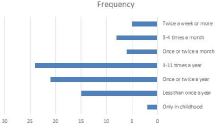
Eighty-one out of one hundred respondents have reported that they had experienced LD at least once through their lifetime. As illustrated in Figure 1., among those who had the experience, 24 (29.6%) reported LD 3 to 11 times a year. 21 (25.9%) recalled LD once or twice a year, and 15 (18.5%) reported less than once a year. 19 other in participants with at least one-time respondents reported having lucid dreams at least once a month. 6 (7.4%) had once or twice a month. 8 (9.9%) 3 to 4 times a month and 5 (6.2%) have experienced more than twice a week.
The mean age of participants with LD experience was 25.12(years) and the calculated total score of the Lucid dreaming questionnaire ranged from 39 to 81 with an average of 62.26±8.97.
Table 1 demonstrates the mean score and standard deviation of every individual question. Only 2 questions have mean scores below 3 and none has a score below the average of 2.5.
As seen in Table 1, 16 out of 17 questions have a strong positive correlation with the total score (p<0.001). Questions number 7 and 8 have a significant correlation with the frequency of LD (p<0.05).
To assess the internal consistency of our scale we measured Cronbach's Alpha as the coefficient of reliability. 0.765 shows that internal consistency is acceptable. Table 2 shows the effect of deleting each item on the total mean, variance and Cronbach's alpha.
Discussion
In LD, the dreamer is aware of the dreaming state. Although the experience is not uncommon, many of the phenomenological aspects of LD are still unclear. In this study, we developed an online questionnaire to collect information about lucid dreaming. Our findings showed that LD has special characteristics that distinguish it from non-lucid dreaming. These differences include the characteristics of the dreamer's experience (such as the ability to think logically, insight, emotion, and control) and the structural differences of the dream (including vivid colors and sounds, linear narrative trajectory, realism, and changeability). In addition, the dreamer may be able to affect the components of the dream, engage in extraordinary activities, or wake up at any time. These differences can also be present after waking up. For example, after waking up from a lucid dream, the person usually mentions either a strong positive or negative feeling, remembers the details of the dream for a longer period of time, and sometimes feels that the dream carries transcendental messages or can affect his waking life as well. Studying the nature of such lucid dreams and how to experience consciousness during them can lead to an understanding of the states of consciousness and its correlates in the brain. The results of these studies can be used to treat diseases such as dementia and schizophrenia [24-26]. In addition, by understanding how this phenomenon occurs, methods can be identified to induce this condition in individuals [27-29]. Aside from the uniqueness of this experience, LD can be used in sleep disorders such as nightmares as well as in the rehabilitation of people with physical disabilities [30-32]. Some find this experience useful for learning and making good use of sleep time [32-35].
In brief, in this study, we designed and present a new questionnaire to evaluate the major dimensions of a lucid dream and determine whether a single dream experience is lucid or not. Besides that, by taking the frequency and general dreaming experience of the respondent into account it would be possible to differentiate a lucid dreamer from a non-lucid dreamer.
Appendix
Lucid dreaming Questionnaire (LDQ): Please read the description below and answer the questions "A Lucid dream is a dream in which the dreamer is aware that he is dreaming. This awareness can occur at any time of the dream and last for any period of time. In some cases, after reaching the clear stage in the dream, the dreamer may be able to master the content of his dream and intervene voluntarily in the course of the dream events. It should be noted that lucid dreaming can happen spontaneously or as a result of the use of special exercises and techniques."
Based on the above text, have you ever had a lucid dream?
Yes
No
Try to estimate the number of times you have experienced lucid dreaming.
I have never experienced a lucid dream in my sleep
I only experienced in childhood
Less than once a year
Once or twice a year 3- 11 times a year 1-2 times a month 3-4 times a month
Twice a week or more
Answer the following questions based on your experiences in lucid dreaming:
1. I am fully aware that I am asleep and dreaming.
2. My dream was so clear that it was as if I was experiencing a scene from waking life.
3. I understood and felt the environment more than other dreams. (e.g. perceiving colors, sounds and smells and feeling pain).
4. While dreaming, I could remember the facts and experiences of my waking life.
5. I was able to perform extraordinary activities that are impossible in the waking state. (e.g. flying, crossing walls, reading people's minds).
6. I was aware of my actions and intentions.
7. I voluntarily decided to wake up.
8. I could voluntarily focus on a specific task or a specific issue.
9. While dreaming, I thought about what I was experiencing.
10. I was thinking about the thoughts and feelings of the characters in the dream.
11. I was thinking about the events that were going on around me.
12. My thoughts, actions and feelings were exactly like my waking life.
13. I tried to do an action but I was not able to perform it successfully. (e.g. I tried to scream but no sound was coming out of my mouth).
14. I woke up from a lucid dream but realized that I was still dreaming.
15. I had a positive feeling when I woke up. (e.g. happiness, joy, excitement).
16. I had a negative feeling when I woke up. (e.g. as fear, anxiety, sadness).
17. After waking up, I felt that the dream had a special message for me.
References
- Mota-Rolim SA, Bulkeley K, Campanelli S, Lobão-Soares B, de Araujo DB, Ribeiro S. The Dream of God: How Do Religion and Science See Lucid Dreaming and Other Conscious States During Sleep? Front Psychol. 2020; 11: 555731.
- Liberation PN. Padmasambhava’s Teachings on the Six Bardos. Wisdom. 1998.
- Filevich E, Dresler M, Brick TR, Kühn S. Metacognitive mechanisms underlying lucid dreaming. The Journal of Neuroscience. 2015; 35: 1082- 1088.
- Kahan TL, LaBerge S. Lucid dreaming as metacognition: Implications for cognitive science. Consciousness and Cognition. 1994; 3: 246-264.
- Dresler M, Eibl L, Fischer CF, Wehrle R, Spoormaker VI, Steiger A, et al. Volitional components of consciousness vary across wakefulness, dreaming and lucid dreaming. Front Psychol. 2013; 4: 987.
- Takahara M, Nittono H, Hori T. Effect of voluntary attention on auditory processing during REM sleep. Sleep. 2006; 29: 975-82.
- LaBerge S. Lucid dreaming: Psychophysiological studies of consciousness during REM sleep. 1990.
- Holzinger B, LaBerge S, Levitan L. Psychophysiological correlates of lucid dreaming. Dreaming. 2006; 16: 88.
- Hearne KMT. Lucid dreams: an elecro-physiological and psychological study. Liverpool University. 1978.
- LaBerge SP. Lucid Dreaming: An Exploratory Study of Consciousness During Sleep. 1980.
- Dresler M, Wehrle R, Spoormaker VI, Koch SP, Holsboer F, Steiger A, et al. Neural correlates of dream lucidity obtained from contrasting lucid versus non-lucid REM sleep: a combined EEG/fMRI case study. Sleep. 2012; 35: 1017-1020.
- Dresler M, Erlacher D, Czisch M, Spoormaker VI. Lucid Dreaming. Principles and Practice of Sleep Medicine. 2017.
- Snyder TJ, Gackenbach J. Individual differences associated with lucid dreaming. Conscious Mind Sleeping Brain. 1988.
- Mota-Rolim SA, Targino ZH, Souza BC, Blanco W, Araujo JF, Ribeiro S. Dream characteristics in a Brazilian sample: an online survey focusing on lucid dreaming. Front Hum Neurosci. 2013; 7: 836.
- Saunders DT, Roe CA, Smith G, Clegg H. Lucid dreaming incidence: A quality effects meta-analysis of 50 years of research. Conscious Cogn. 2016; 43: 197-215.
- La Berge SP. Lucid dreaming as a learnable skill: A case study. Perceptual and Motor Skills. 1980; 51: 1039-1042.
- Worsley A. Personal experiences in lucid dreaming. Conscious mind, sleeping brain.1988.
- Schredl M, Rieger J, Göritz AS. Measuring lucid dreaming skills: A new questionnaire (LUSK). International Journal of Dream Research. 2018; 11: 54-61.
- Baird B, Mota-Rolim SA, Dresler M. The cognitive neuroscience of lucid dreaming. Neurosci Biobehav Rev. 2019; 100: 305-323.
- Stumbrys T, Erlacher D, Johnson M, Schredl M. The phenomenology of lucid dreaming: An online survey. Am J Psychol. 2014; 127: 191-204.
- Kahan TL, Sullivan KT. Assessing metacognitive skills in waking and sleep: A psychometric analysis of the Metacognitive, Affective, Cognitive Experience (MACE) questionnaire. Consciousness and Cognition. 2012; 21: 340-352.
- Aviram L, Soffer-Dudek N. Lucid Dreaming: Intensity, But Not Frequency, Is Inversely Related to Psychopathology. Front Psychol. 2018; 9: 384.
- Voss U, Schermelleh-Engel K, Windt J, Frenzel C, Hobson A. Measuring consciousness in dreams: the lucidity and consciousness in dreams scale. Conscious Cogn. 2013; 22: 8-21.
- Dresler M, Wehrle R, Spoormaker VI, Steiger A, Holsboer F, Czisch M, et al. Neural correlates of insight in dreaming and psychosis. Sleep Med Rev. 2015; 20: 92-99.
- Mota NB, Resende A, Mota-Rolim SA, Copelli M, Ribeiro S. Psychosis and the Control of Lucid Dreaming. Front Psychol. 2016; 7: 294.
- Laureys S, Perrin F, Brédart S. Self-consciousness in non-communicative patients. Conscious Cogn. 2007; 16: 722-741.
- Stumbrys T, Erlacher D, Schadlich M, Schredl M. Induction of lucid dreams: a systematic review of evidence. Conscious Cogn. 2012; 21: 1456- 1475.
- Stumbrys T, Erlacher D, Schredl M. Testing the involvement of the prefrontal cortex in lucid dreaming: a tDCS study. Conscious Cogn. 2013; 22: 1214-1222.
- Voss U, Hobson A. What is the state-of-the-art on lucid dreaming?-Recent advances and questions for future research. Psychology. 2014.
- Morgenthaler TI, Auerbach S, Casey KR, Kristo D, Maganti R, Ramar K, et al. Position paper for the treatment of nightmare disorder in adults: an American Academy of Sleep Medicine position paper. J Clin Sleep Med. 2018; 14: 1041-1055.Erlacher D, Schredl M. Practicing a motor task in a lucid dream enhances subsequent performance: A pilot study. Sport Psychologist. 2010; 24: 157-167.
- Stumbrys T, Erlacher D, Schredl M. Effectiveness of motor practice in lucid dreams: A comparison with physical and mental practice. J Sports Sci. 2016; 34: 27-34.
- Tholey P. Applications of lucid dreaming in sports. Lucidity Letter. 1991.
- Erlacher D, Stumbrys T, Schredl M. Frequency of lucid dreams and lucid dream practice in German athletes. Imagination Cognition and Personality. 2012; 31: 237-246.
- Purcell S, Mullington J, Moffitt A, Hoffmann R, Pigeau R. Dream self- reflectiveness as a learned cognitive skill. Sleep. 1986; 9: 423-437.
Figures
Tables
Table 1: Means and standard deviation of each question and its correlation to LD frequency and total score.
| Question No. | Mean ± SD | Correlation with Frequency1 | Correlation with Total score1 |
|---|---|---|---|
| 1 | 4.37±0.73 | 0.023 | 0.390** |
| 2 | 4.28±0.79 | -0.028 | 0.449** |
| 3 | 3.63±1.145 | -0.009 | 0.491** |
| 4 | 4.09±0.809 | 0.109 | 0.453** |
| 5 | 3.22±1.432 | 0.050 | 0.447** |
| 6 | 3.59±1.181 | 0.188 | 0.648** |
| 7 | 2.89±1.342 | 0.340** | 0.364** |
| 8 | 3.38±1.220 | 0.224* | 0.594** |
| 9 | 3.98±1.000 | 0.102 | 0.668** |
| 10 | 3.65±1.063 | 0.191 | 0.596** |
| 11 | 4.01±0.915 | 0.185 | 0.591** |
| 12 | 3.77±1.110 | 0.031 | 0.591** |
| 13 | 3.94±1.017 | 0.092 | 0.351** |
| 14 | 2.81±1.574 | 0.038 | 0.551** |
| 15 | 3.43±1.294 | 0.066 | 0.434** |
| 16 | 3.52±1.324 | -0.094 | 0.176 |
| 17 | 3.69±1.231 | 0.063 | 0.413** |
| Total score (min- max) | 62.26±8.975 (39-81) | 0.167 | 1 |
1Spearman Rank correlations, * p < 0.05, ** p<0.001.
Table 2: Effects on the scale mean, variance, total correlation and Cronbach's Alpha if any of the questions were deleted.
| Question No. | Scale Mean if Item Deleted | Scale Variance if Item Deleted | Corrected Item-Total Correlation | Cronbach's Alpha if Item Deleted |
|---|---|---|---|---|
| 1 | 57.89 | 76.925 | 0.240 | 0.762 |
| 2 | 57.98 | 74.599 | 0.387 | 0.754 |
| 3 | 58.63 | 71.586 | 0.395 | 0.751 |
| 4 | 58.17 | 74.920 | 0.355 | 0.755 |
| 5 | 59.04 | 71.136 | 0.305 | 0.760 |
| 6 | 58.67 | 68.900 | 0.523 | 0.740 |
| 7 | 59.37 | 73.711 | 0.218 | 0.767 |
| 8 | 58.88 | 69.035 | 0.494 | 0.742 |
| 9 | 58.28 | 70.356 | 0.548 | 0.740 |
| 10 | 58.60 | 70.992 | 0.470 | 0.745 |
| 11 | 58.25 | 72.588 | 0.457 | 0.748 |
| 12 | 58.49 | 69.303 | 0.542 | 0.739 |
| 13 | 58.32 | 75.596 | 0.221 | 0.764 |
| 14 | 59.44 | 67.725 | 0.399 | 0.751 |
| 15 | 58.83 | 72.070 | 0.310 | 0.758 |
| 16 | 58.74 | 79.144 | -0.015 | 0.787 |
| 17 | 58.57 | 72.098 | 0.331 | 0.756 |