
Management of Severe Periodontitis in Hemodialysis Patient: A Case Report
1 Department of Periodontology, University Hassan II of Casablanca, Morocco
2 Department of Removable Prosthodontology, University Hassan II of Casablanca, Morocco
Citation: Rafii A, Amine K, El Battahi I, Kissa J. Management of Severe Periodontitis in Hemodialysis Patient: A Case Report. SF J Dent. 2021;4(1):1027.
Abstract
A chronic kidney disease or chronic renal failure is a progressive loss of renal functions; which can lead to several systemic complications and oral manifestations such as the periodontitis.
This article describes a case report of a 28-year-old female hemodialysis patient presented generalized severe aggressive periodontitis. The therapy phase included oral hygiene instruction, periodontal treatment and extraction of teeth with hopeless prognosis, with the collaboration of her nephrologist doctor.
Anterior teeth extracted were replaced immediately by partial denture prosthesis.
Keywords: Chronic renal failure; Aggressive periodontitis; Dialysis; Periodontal therapy; Immediate prosthesis
Abbreviations
CRF: Chronic Renal Failure; CKD: Chronic Kidney Disease
Introduction
The chronic renal failure (CRF) is a public health problem [1]; it results from progressive and chronic deterioration of nephrons [2]. Therefore, it is necessary to employ extra-renal blood filtering techniques (most frequently hemodialysis) [3]. CRF can have many consequences, as a greater bleeding tendency, anemia, drug intolerance, in addition to the presence of several oral manifestations with increased prevalence and severity of periodontitis.
The dentist must consider these disorders when treating hemodialysis patients [4]. The purpose of this case report was to describe the management of generalized and severe aggressive periodontitis in patient suffering from a terminal chronic renal failure.
Case Presentation
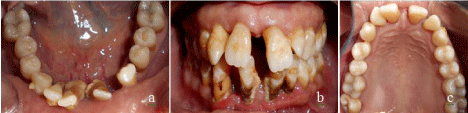
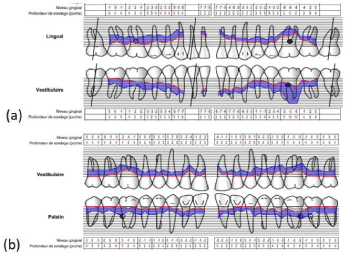
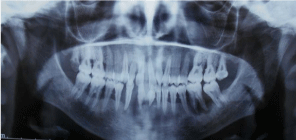
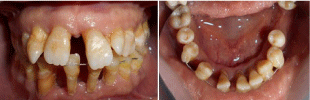
A 28-years-old woman was consulted for dental migration and mobility associated with gingival pain. Her medical history showed that she has a CRF and she started renal hemodialysis since the age of 15. The patient undergoes dialysis 3 times a week and takes two medication a day (calcium carbonate 1g, Alfacalcidol 0.25μg). Intra oral examination revealed a poor oral hygiene with heavy plaques and calculus (Loe and Silness Plaque Index (1964)=2,25), gingival inflammation (Loe and Silness Gingival index (1967)=2,16), polydiastema, gingivals recessions especially in the anterior region of the mandible, the absence of 42 and residues of an old contention (Figure 1). The periodontal charting revealed a generalized clinical attachment loss, especially deeper in the mandibular anterior teeth and in the left mandibular first molar (36) (Figure 2). The clinical and radiological (Figure 3) examinations allowed making the diagnosis of severe generalized aggressive periodontitis in a context of chronic renal failure. According to McGuire prognosis classification system, the teeth 36-32-31-41-43 had hopeless prognosis (terminal resorption bone, Miller class IV mobility, 1950).
Treatment plan
The protocol of management according to his nephrologist:
Prophylactic antibiotherapy: 1g of Amoxicilline+125mg of Clavilanique Acid, 2 times a day (the day before+the duration of dental treatment). Dental treatment far from the sessions of dialysis.
Initial therapy: Oral hygiene instruction. Contention from 34 to 44 (to facilitate impression for immediate denture). Supra- and subgingival scaling and root planning.
Antibiotherapy: The ATB (Amoxicilline+Clavilanique Acid) was taken during 7j, because the patient presents an aggressive periodontitis.
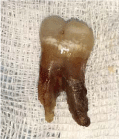
Extraction of 18-28-36 (important caries in 18-28 and severe bone loss with external radicular resorption in 36 (Figure 4)).
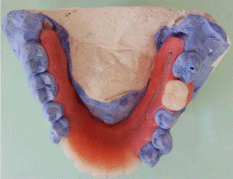
Preparation of the immediate prosthesis replacing 43-42-41-31- 32 (Figure 5), which had hopeless prognosis at this young patient.
This prosthesis is going to remedy the esthetic, functional and moral prejudice [5].
Reevaluation (after four months): Clinical examination showed reduction of Loe and Silness plaque and gingival index, diminution of bleeding on probing and pocket depth from 4-6mm to 2-5mm. Slight increase of gingival recession, with occurrence of supragingival calculus (Figure 6).
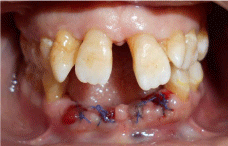
After periodontal examination, and reinforcement of oral hygiene instructions, we redid the scaling, and we deposited of the contention. Extractions of the teeth (43-41-31-32) with severe bone loss were done; the sutures and haemostatic sponges were placed (Figure7).
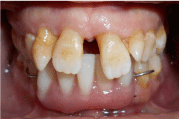
At the end of the intervention, immediate partial prosthesis was inserted after disinfection in Chlorhexidine solution, and the instructions post insertion were given to the patient (Figure 8).
Corrective therapy: The patient is going to require an orthodontic treatment further to the presence of the malocclusions, and a final prosthesis.
Maintenance therapy: A regular maintenance is important in this hemodialysis patient, because of increased plaque, calculus and gingival inflammation, an increased incidence and severity of periodontitis [6].
Discussion
The kidneys are two organs found on the left and right sides of the body in vertebrates [7], their essential functions are:
Metabolism and excretion of the end products of metabolism.
Regulation of blood fluid volume and electrolyte concentration.
Secretion of erythropoietin.
Maintenance of calcium homeostasis through the hydroxylation of vitamin D3 into active or inactive metabolites [4].
All these functions are affected in chronic renal failure [8], associated to an increase of serum creatinine and blood uric nitrogen levels.
The most frequent causes of CRF are hypertension, diabetes mellitus, chronic glomerulonephritis, uropathy and autoimmune diseases [9].
The chronic renal failure patients are at high risk of developing oral health complications [2], such as [9-12]:
Xerostomia, Oral bleeding, Stomatitis, Pale gingivae, Druginduced gingival hyperplasia, Abnormal bone remodeling after extraction, Tooth mobility, Loss of lamina dura, Malocclusion, Poor oral hygiene with increased prevalence of calculus and periodontitis. A Moroccan study of 42 adult hemodialysis patients reported that periodontitis was noted in 73% of the cases [13].
The high rate of the periodontal diseases can be explained by specific factors in insufficient renal:
Psychological stress (long sessions (3–5 h), thrice-weekly) [4].
Gingival bleeding is caused by bacteriemia and it is aggravated by renal anemia, the dysfunction of the endothelial cells, and the use of anticoagulants [14].
Nutritional deficiencies (severe vitamin C deficiency and deficiencies of several essential amino acids) resulting from the dialysis procedure [4].
Immune dysfunction secondary to chronic uremia and defects in innate and adaptive immunity [2,4].
Several studies suggest that periodontal therapy may decrease systemic inflammation caused by calculus and periodontitis as well as endothelial dysfunction [2,4], then a periodontal treatment may be beneficial to the course of chronic kidney disease (CKD) [15].
Implant treatment can be used to restore the missing teeth, but the systemic condition of the hemodialysis patients and the dialysis treatment can complicate this treatment. Therefore, the implant rehabilitation must be carefully planned using the simplest possible treatment to avoid possible complications [10].
Dental management must be adapted to these patients’ special conditions:
Prolonged bleeding, because of platelet dysfunction and the use of anticoagulants for hemodialysis [10].
Alteration in drug administration because of decreased glomerular filtration rate,
Increased susceptibility to infections. Infective endocarditis is one of the most common causes of the increased mortality and morbidity in CKD patients;
Increased risks of parenterally transmitted infections such as HIV, HBV, and HCV [14].
For a good periodontal therapy in terminal CRF patient, the dentist should respect some recommendations:
Instructions of the patient in the importance of effective oral hygiene procedures and regular controls.
Close communication between the dentist and a nephrologist [4].
Application of local hemostatic measures such as mechanical pressure, suturing, topical thrombin and performing dental treatment on non-dialysis days [16].
Using antibiotic prophylaxis, to prevent local or distant infection [9] and to protect vascular access sites [6].
Adopting of universal precautions to prevent the infection of dental personnel and cross-contamination in the dental clinic [14].
Adaptation of the dosage and the administration of drugs cleared by the kidneys [4] (Table 1).
Conclusion
Hemodialysis patients are at high risk for developing periodontal disease and oral complications. A close collaboration between medical doctor and dentists is essential for the preventing and early dental treatment [2,9].
References
- Artese HP, Sousa CO, Luiz RR, Sansone C, Torres MC. Effect of nonsurgical periodontal treatment on chronic kidney disease patients. Braz Oral Res. 2010; 24: 449-454.
- Nguyen LDA, Nguyen TTT, Pham TAV. Periodontal status in chronic kidney disease patients. UIP Health Med. 2016; 1: 155-161.
- Gavaldá C, Bagán J, Scully C, Silvestre F, Milián M, Jiménez Y. Renal hemodialysis patients: oral, salivary, dental and periodontal findings in 105adult cases. Oral Dis.1999; 5: 299-302.
- Ronald G, Kotanko P. A clinician's guide to systemic effects of periodontal diseases. Springer. 2016.
- Vinaya B, Sriram Balaji S. Immediate partial denture prosthesis - a case report. NUJHS. 2013; 3: 120-124.
- Craig RG. Interactions between chronic renal disease and periodontal disease. Oral Dis. 2008; 14: 1-7. 7. https://en.wikipedia.org/wiki/Kidney. 8. Bernard L, Ziad M. Diagnostic, suivi biologique de l’insuffisance rénale chronique et prise en charge de l’insuffisance rénale chronique terminale. RFL. 2013; 43: 59-73. 9. Hamissi J, Mosalaei S. Periodontal condition in chronicrenalpatients: a case report. Pakistan Oral and Dental Journal. 2008. 10. Yuan Q, Xiong QC, Gupta M, López-Pintor RM, Chen XL, Seriwatanachai D, et al. Dental implant treatment for renalfailure patients on dialysis :aclinical guideline. Int J Oral Sci. 2017; 9: 125-132. 11. Proctor R, Kumar N, Stein A, Moles D, Porter S. Oral and Dental Aspects of Chronic Renal Failure. J Dent Res. 2005; 84: 199-208. 12. Marinho JSS, Carmona IT, Loureiro A, Posse JL, Caballero LG, Dios PD. Oral health status in patients with moderate-severe and terminal renal failure. Med Oral Patol Oral Cir Bucal. 2007; 12: E305-E310. 13. Bouattar T, Chbicheb S, Benamar L, El Wady W, Bayahia R. Dental status in 42 chronically hemodialyzed patients. Rev Stomatol Chir Maxillofac. 2011; 112: 1-5. 14. Dioguardi M, Caloro GA, Troiano G, Giannatempo G, Laino L, Petruzzi M, et al. Oral manifestations in chronic uremia patients. Ren Fail. 2016; 38: 1-6. 15. Almeida S, Figueredo CM, Lemos C, Bregman R, Fischer RG. Periodontal treatment in patients with chronic kidney disease: a pilot study. J Periodontal Res. 2017; 52: 262-267. 16. Klassen JT, Krasko BM. The dental health status of dialysis patients. J Can Dent Assoc. 2002; 68: 34-38.
Figures
Tables
Table 1: Drugs Commonly Used in Dentistry That May Have Implications for Patients with Renal Disease.
| Drug | Caution | |
|---|---|---|
| scitoibitnA | Amoxicillin | Reduce dose: 250-500 mg every 8 h. |
| ampicillin | 1-2 g Ampicillin and 0.5-1 g Sulbactam every 6-8 h [10]. | |
| Erythromycin | Maximum 1.5 g daily (ototoxicity). | |
| Tetracyclines | Avoid-use doxycycline or minocycline if necessary (avoid excessive doses). | |
| Cefalexin, cefradine | Reduce dose [11]. | |
| scitehtsenA | Lidocaine Mepivacaine Articaine | No adjustment needed [10]. |
| sciseglanA | Aspirin | Avoid (water retention; deterioration in renal function; risk of gastric hemorrhage). |
| Ibuprofen | Avoid if possible/use lowest effective dose, monitor renal function (sodium, water retention; deterioration in renal function) [11]. | |
| Paracetamol | 300-600 mg every 4 h [10]. | |
| rehtO sgurd | Povidone-iodine | Avoid regular application to inflamed or broken mucosa [11]. |
| Acyclovir (antiviral) | Reduce dose (200-800 mg every 4-12 h) [10]. | |