
Clinical and Urodynamic Studies in 50 Patients with Urinary Problem in Stage III and Stage IV Uterine Prolapse
Consultant Obstetrician and Gynaecologist, Shanthi Nagar, Bangalore, Karnataka, India
Citation: Roopa M. Clinical and Urodynamic Studies in 50 Patients with Urinary Problem in Stage III and Stage IV Uterine Prolapse. SF J Gynecol Obstet. 2021;4(1):1014.
Abstract
Background: Stage III and IV uterine prolapse are associated with urinary incontinence. Type of urinary continence, symptoms and relation to urodynamic studies has been variably described.
Methods: Design of the study. It was prospective interventional study. Setting study was conducted in tertiary care teaching hospital in south India.
Participants: 51 patients with grade III and grade IV prolapse.
Intervention: Urinary symptoms evaluation and urodynamic study was done before and after pessary.
Results: 9 patients with clinical incontinence were normal urodynamically. Improvement in incontinence in 30 patients after pessary insertion versus 13 patients without pessary insertion. Improvement was very obvious in stress incontinence group. There was no serious complications observed while using pessary.
Conclusion: Clinical symptoms are primary in the diagnosis of urinary incontinence with uterine prolapse, complemented by urodynamic study. Pessary insertion in patients with urinary incontinence, particularly stress incontinence, in those with grade III and IV prolapse decreases the urinary incontinence.
Keywords: Mixed incontinence; Stress incontinence; Urge incontinence
Introduction
Gynaecologists have pondered for years the paradox that while moderate pelvic floor relaxation is associated with genuine stress urinary incontinence, women with prolapse outside the introitus rarely complain of incontinence. It may not be brought to notice as it does not bother for some while embarrassing or only surgical option belief for others. It makes care giver to ask pertinent questions. Studies have shown that there is little relationship between the volume of urine lost and the distress that it causes a patient. The degree to which women are bothered by leakage is influenced by various factors including cultural values and expectations regarding urinary incontinence [1,2]. In observational study involving 202 patients with urinary symptoms, detailed history, pelvic examination and introital sonography were compared with urodynamic study. Most prevalent complaint was mixed urinary incontinence (33.17%), followed by stress incontinence (31.68%) and urge incontinence (13.37%). 66.33% were normal o urodynamic studies. Authors concluded that none of the urodynamic parameters individually or in combination were found to be very useful for establishing a diagnosis [3]. The analysis of retrieved data showed that pessaries constitute important, non-surgical, firs tine option for urinary incontinence with genitourinary prolapse especially for Stress Urinary Incontinence (SUI) with high patient satisfaction rate and relatively free of major complications if they are fit properly [4]. A 75% of women were satisfied with behavioural therapy, while only 33% were satisfied with a pessary at 3 months, but at 12 months the success rate declined in both groups and the statistically significant difference in outcome between the two groups was no longer present in one randomised control trial [5]. Prolapse has been shown to urodynamically increase urethral resistance. There is also at increased risk for SUI after surgical correction of prolapse in May as high as 16% after anterior colporrhaphy or manifest with reduction of prolapse. There has been scanty literature availability on Mixed Urinary Incontinence (MUI). This study was undertaken to determine the frequency of abnormal urodynamic test in women with genitourinary prolapse.
Material and Methods
Objective of study
To determine the prevalence of urinary incontinence in patients with severe genitourinary prolapse, to correlate clinical urinary incontinence with urodynamic studies and effect of pessary insertion on urinary incontinence.
Design of the study
It was prospective interventional study. Setting: Study w.
Participants
51 patients admitted with diagnosis of grade III and grade IV prolapse in the Department of Obstetrics and Gynaecology, Kasturba Medical College, Mangalore, were enrolled after written consent.
Exclusion criteria
Patients with diagnosis of urinary tract infection. Detailed demographic information or other obvious pathology, urinary symptoms, underlying comorbid conditions, examination findings, investigations, treatment were recorded in predesigned proforma. Definition for the clinical diagnosis of urinary problems were as per ICS. Urinary incontinence was defined as involuntary loss of urine which is objectively demonstrable and a social or hygienic problem. Stress urinary incontinence was defined as involuntary loss of urine when intra-vesical pressure exceeds the urethral closing pressure in absence of detrusor instability and is objectively demonstrable [5]. Urge incontinence was defined as Unstable bladder as shown objectively to contract spontaneously or on provocation during filling phase, while the patient is attempting to inhibit the micturition. Mixed Urinary incontinence was defined as presence of both urge incontinence and stress incontinence in the in the same patient. Over active bladder was defined as urgency with or without urge incontinence, frequency, nocturia with no proven infection. Patients were investigated urine sugar, microscopy, urinary protein and urine culture and sensitivity for ruling out urinary tract infection and any other urinary tract pathology [6].
Subsequently urodynamic study was carried out as per the standard described technique and values were recorded. Pessary insertion was carried out followed by repeation of urodynamic study. Aim of urodynamic study was to reproduce patient symptoms and to synchronous urodynamic events, define detrusor function and urethral function during both filling and voiding [7].
Vaginal ring pessary was inserted to ensure complete reduction of prolapse in an attempt to restore the normal urethral axis. Examination, Urodynamic test was repeated after pessary placement. Based on urodynamic findings patients were grouped into: 1. SUI; 2. UUI; 3. Mixed incontinence (MUI) and 4. No urodynamically detected abnormality.
Statistical analysis
Results were analysed using microsft xl and SSPS version 16 for mean, range, standard deviation calculation, and cross tabulation.
Results
Age of study patients was 55.5 years +/-10.269 years (mean=/- SD) with range 21 years to 70 years. Majority were post-menopausal women with 44 (86.3%) out 51 belonging to this group (Table1). Multipara topped the category followed by grand multipara and
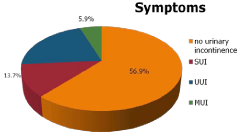
nullipara with 37 (72.5%), 13 (25.4%) and 1 (2%) respectively (Table 2). Stage 3 prolapse was present in thirty two out of 51 patients (62.7%) (Table 3). There was no urinary incontinence in 56.9%, UUI in 23.5%, SUI in 13.7% and MUI in 5.9% of patients (Figure 1). Urodynamic SUI was present in 16 and 4 patients before and after pessary insertion (Table 5). There was no change in frequency of UUI with pessary application (Table 6). There was decrease in number from 7 to 2 urodynamically significant MUI after pessary insertion (Table 7).
Twenty two patients were having clinical symptoms of UI. Thirty patients were found be positive for urodynamic study. Urodynamic study increased the diagnostic chance in asymptomatic or no revealing patients by 36%. Nine symptomatic UI were negative for urodynamic study. Pessary decreased urodynamic significant UI from 30 to 13 (Table 8).
Pessary insertion decreased SUI (from 31.4% to 7.8%) more than MUI. It had no effect on detecting UUI (Table 9). Occult SUI was more frrequent in stage 4 prolapse than stage 3 prolapse (Table 10).
Discussion
ICS definition
Involuntary loss of urine when the intra-vesical pressure exceeds more than urethral closure pressure, In absence of detrusor instability, which is a social or a hygienic problem that is objectively demonstrable. People usually present with involuntary leakage of urine on effort, exertion or on sneezing or coughing [5]. Observation of involuntary leakage from the urethra, synchronous with exertion/ effort or sneezing, coughing that is when the intravesical pressure exceeds more than urethral closure pressure in incontinence.
In the present study 23.5% of patients with stage II/III had occult urinary incontinence compared to a study by Bruce A et al., [8] where 59% had occult urinary incontinence and 58% in a study by David C et al., [9].
The patient with hyper mobility and stress incontinence is usually cured if the hyper mobility is corrected [4,10]. Positive benefits were observed in present study too significant improvement in urodynamically significant UI as reflected in Table 8. There improvement urodynamically in 17 more patients after pessay
insertion. Having urethral hyper mobility and having clinical stress incontinence is not the same thing as observed in one study [9]. 9 clinically diagnosed were urodynamically significant as noticed in present study. Many women with severe stress incontinence have no urethral mobility at all and many women with incontinence among two other causes (Eg: detrusor instability) also have urethral hyper mobility as a coincidental finding that is irrelevant to their main problem [10,11]. No single bladder neck position is uniformly associated with continence or with incontinence. Patients who have stress incontinence in the presence of normal urethral support are different.
Limitations of study
Sample size was small. It was single entry study.
Conclusion
Pre-operative urodynamic evaluation before and after prolapse reduction is advised for correct diagnosis of urinary incontinence in patients with genitourinary prolapse. Establishment of the final diagnosis of urinary incontinence and planning of management should be based on detailed history, physical examination, bladder diaries, and careful interpretation of urodynamic data. Urodynmic study is supplementary to clinical diagnosis, not a substitute. Pessary insertion in stage III and IV uterine prolapse improves the urinary incontinence.
References
- 2. Harris SS, Link CL, Tennstedt SL, Kusek JW, McKinlay JB. Care seeking and treatment of urinary incontinence in a diverse population. J Urol. 2007; 177: 650-654.
- 5. Richter HE, Burgio KL, Brubaker L, Nygaard IE, Ye W, Weidner A, et al. Continence pessary compared with behavioral therapy or combined therapy for stress incontinence: a randomized controlled trial. Obstet Gynecol. 2010; 115: 609-617.
- 6. Abrams P, Blaivas JG, Stanton SL, Andersen JT. The standardisation of terminology of lower urinary tract function. The International Continence Society Committee on Standardisation of Terminology. Scand J Urol Nephrol Suppl. 1988; 114: 5-19.
- 7. Sutherst JR, Brown MC. Comparison of single and multichannel cystometry in diagnosing bladder instability. Br Med J. 1984; 288: 1720- 1722.
- 8. Rosenzweig BA. Genital prolapse and lower urinary tract dysfunction. Int
- Urogynecol J. 1993; 4: 296-300.
- 9. Reynolds WS, Dmochowski RR, Penson DF. Epidemiology of Stress
- Urinary Incontinence in Women. Curr Urol Rep. 2011; 12: 370-376.
- 10. Glass J, Mundar AR. Susan Standing. Bladder. 1978; 28: 1289-1294.
- 11. Weidner AC, Myers ER, Visco AG, Cundiff GW, Bump RC. Which women with stress incontinence require urodynamic evaluation. Am J Obste Gynaecol. 2001; 184: 20-27.
Figures
Tables
Table 1: Showing age and BMI distribution of study population.
| N | Min | Max | Mean | Std. Deviation | |
|---|---|---|---|---|---|
| Age | 51 | 21 | 70 | 55.55 | 10.269 |
| BMI | 51 | 20 | 29 | 24.90 | 2.555 |
86.3
Table 2: Proportion of premenopausal and post-menopausal women in study.
| Menopause | ||
|---|---|---|
| Frequency | Percent | |
| Post Menopause | 44 | 86.3 |
| Pre Menopause | 7 | 13.7 |
| Total | 51 | 100 |
72.5%
Table 3: Showing parity distribution in study patients.
| Parity | Frequency | % |
|---|---|---|
| Nullipara | 1 | 2% |
| Multipara | 37 | 72.5% |
| Grandmulti | 13 | 25.4% |
Table 4: Showing frequency of stage of prolapse in study population.
| Stage of Prolapse | ||
|---|---|---|
| Frequency | Percent | |
| III | 32 | 62.7 |
| IV | 19 | 37.3 |
| Total | 51 | 100 |
Table 5: Depicting SUI before and after pessary insertion.
| Urodynamic SUI before pessary | Urodynamic SUI after pessary | |
|---|---|---|
| Absent | 35 (68.6%) | 47 (92.1%) |
| Present | 16 (31.4%) | 4 (7.8%) |
Table 6: Depicting UUI before and after pessary insertion.
| Urodynamic UUI before pessary | Urodynamic UUI after pessary | |
|---|---|---|
| Absent | 44 (86.3%) | 44 (86.3%) |
| Present | 7 (13.7%) | 7 (13.7%) |
Table 7: MUI frequency before and after pessary insertion.
| Urodynamic MUI before pessary | Urodynamic MUI after pessary | |
|---|---|---|
| Absent | 44 (86.3%) | 49 (96.1%) |
| Present | 7 (13.7%) | 2 (3.9%) |
Table 8: Correlation symptoms with urodynamic study before and after pessary insertion.
| Symptomatic | Symptomatic | Urodynamic before pessary insertion | Urodynamic after insertion of pessary | |
|---|---|---|---|---|
| 1 | SUI | 7 (13.7%) | 16 (31.4%) | 4 (7.8%) |
| 2 | UUI | 12 (23.5%) | 7 (13.7%) | 7 (13.7%) |
| 3 | MUI | 3 (5.8%) | 7 (13.7%) | 2 (3.9%) |
Table 9: Comparison between stage of prolapse and urinary incontinence.
| POP | No. of patients with occult SUI (%) | No. of patients with occult UUI (%) | No. of patients with occult MUI (%) |
|---|---|---|---|
| Stage III (n=32) | 6 (18.7%) | 0 | 1 (1.9%) |
| Stage IV (n=19) | 6 (31.5%) | 0 | 3 (5.8%) |
40.9% 40.9% 1. Cheater FM, Castleden CM. Epidemiology and classification of urinary incontinence. Best Pract Res Clin Obstet Gynaecol. 2000; 14: 183-205. 13.7% 23.5% 5.8%
Table 10: Comparison of urinary incontinence with different studies.
| SUI | UUI | MUI | Total | |
|---|---|---|---|---|
| Bruce A, Rosenzweig et al., | 40.9% | 40.9% | 23% | 59% |
| Present study | 13.7% | 23.5% | 5.8% | 43% |
| Dvid C, Chalkin et al., | 58% | - | - | 58% |
3. Pandey D, Anna G, Hana O, Christian F. Correlation between clinical presentation and urodynamic findings in women attending urogynecology clinic. J Midlife Health. 2013; 4: 153-159. 4. Al-Shaikh G, Syed S, Osman S, Bogis A, Al-Badr A. Pessary use in stress urinary incontinence: a review of advantages, complications, patient satisfaction, and quality of life. Int J Womens Health. 2018; 10: 195-201.